
Joshua Tree National Park’s kid-friendly trails offer families with young adventurers easy and interactive ways to explore the park’s rugged beauty, otherworldly geography, and best desert features. The park’s diverse trails provide a perfect blend of accessible routes for little explorers and challenging paths for older kids. Getting up close with massive boulders, checking out the park’s fantastical vegetation, and interacting with trail-side exhibits help kids and families to connect with Joshua Tree’s unique environment.
Check out these favorite kid-friendly Joshua Tree trails:
1. Discovery Trail
Discovery Trail is a fun and easy .7-mile (1.1 km) loop hike designed especially for young explorers. Discovery Trail loops around the boulder fields opposite Skull Rock, sharing easy-to-understand details along the way about Joshua Tree’s unique and unusual features. Great for families, the trail was developed by local kids from the Morongo Unified School District under guidance from park rangers in 2012, and built by high school students from the Youth Conservation Corps in 2013. Discovery Trail gives visitors of all ages an opportunity to stretch their legs, have fun exploring, and learn about Joshua Tree’s best highlights.
Find the trailhead for the Discovery Trail at the parking pullout on the northwest side of Park Boulevard opposite Skull Rock, .6 miles northeast of Jumbo Rocks Campground.
2. Skull Rock Nature Trail
Attention desert adventurers and wild buccaneers! Unfurl those maps, it’s time to uncover a trove of desert treasures on this moderately easy 1.7-mile (2.7 km) loop around Joshua Tree’s scariest star, Skull Rock! Skull Rock, a roadside favorite, guards a loop trail around a cache of natural wonders in the heart of Joshua Tree. Way signs along the nature trail reveal the park’s best surprises.
Skull Rock haunts the Mojave Desert .7 miles east of Jumbo Rocks Campground, right off of Park Boulevard. Convenient parking is available at the pullouts on both sides of the road. The trailhead for Skull Rock Nature Trail is on the south side of Park Boulevard, near Skull Rock. This entrance will take hikers to famous Skull Rock first, and then around the trail in a clockwise direction. (There are also trail entrances at Jumbo Rocks Campground, and on the north side of Park Boulevard.)
3. Indian Cove Nature Trail
Indian Cove Nature Trail is a very easy .6-mile (1 km) loop in northern Joshua Tree that explores a key hub of human history and an intriguing desert alcove brimming with life. Handy information placards along the trail give hikers an inside look into the region’s unique desert ecosystem, its surprisingly diverse biome, and how its hardy inhabitants thrive in this exceptional region. This short, relatively flat trail is perfect for families and dips into a dry wash for an easy-going interpretive stroll that can also serve as a warm-up hike for later adventures.
Find Indian Cove Nature Trail at the end of Indian Cove Road West, at the western end of Indian Cove Campground, beyond campsites #89 & #90. There is a small parking area at the end of the road loop by the trailhead. The trail starts at the northwest end of the parking loop, between the small wooden fences. (Note that a dirt tract extends directly in front of the parking area. This heads to Sneakeye Spring and is not the correct path.)
4. Cottonwood Spring Oasis
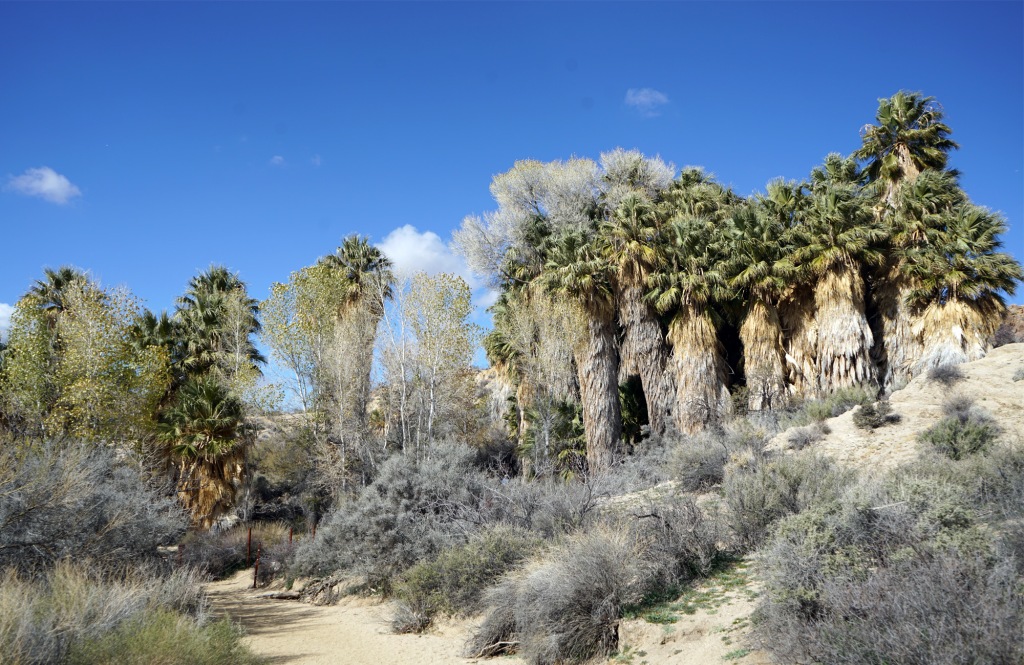
Families with kids are going to love this stroll out to a lush, palm-lined oasis on a very easy walk to Cottonwood Spring. Trek in the footsteps of miners, see the ingenious ways Indigenous people harnessed the desert landscape, and keep an eye out for thirsty bighorn sheep enjoying a favorite watering hole. Primitive-looking California fan palms, the only native palm to Southern California, welcome visitors of all ages to this historic wayside stop. This unique spring-fed microhabitat supports a remarkable array of flora and fauna and is a very popular birding spot. Interpretive signs along the path highlight the oasis’s fascinating features, and a bench at the oasis offers a spot for relaxation and reflection. Sightseers interested in archaeology should check out the nearby mortar stones used to crush nuts and seeds into flour, which points to long-ago human history.
Find the path to Cottonwood Spring Oasis at the parking area at the end of Cottonwood Oasis Road. Cottonwood Oasis Road is near the Cottonwood Visitor Center, by the junction of Cottonwood Spring Road and Pinto Basin Road. From Cottonwood Oasis Road, go past Cottonwood Campground to reach the parking area.
5. Hidden Valley Nature Trail
Rustle up a good time on the Hidden Valley Nature Trail! This moderately easy 1-mile (1.6 km) loop trail slips through a secret passageway between rocks to explore a fascinating valley once used as a hideaway by thieves and bandits to stash stolen livestock. Interpretive signs along the trail showcase the area’s cool flora and fauna, and Joshua Tree National Park’s famous monzogranite formations provide excellent challenges for rock climbers and boulderers. With plenty of interesting things to discover, Hidden Valley Nature Trail is a family favorite.
The parking area for Hidden Valley Nature Trail is located off of Park Boulevard, at the end of the turnoff on the southwest side of the road, about 600 feet north of the intersection of Park Boulevard and Barker Dam Road, near the Hidden Valley Picnic Area.
6. Cholla Cactus Garden
With supervision, young explorers can walk on the wild side at the Cholla Cactus Garden! Treacherous “jumping teddy bears” wait to strike with spiky spines on this precariously easy (or easily precarious!) path through a precious garden of desert dangers. This flat quarter-mile (.4 km) loop takes thrill-seekers and curious passersby through a prickly stand of dangerously cute cacti and other vegetation fascinations on a short-and-spiky nature walk. The Cholla (pronounced choy-yah) Cactus Garden nature walk is perfectly safe… so long as you resist the urge to cuddle the adorable succulents!
Cholla Cactus Garden is located in the center of Joshua Tree National Park, off of Pinto Basin Road, about 18 miles southeast of Oasis Visitor Center and 20 miles northwest of Cottonwood Visitor Center. Find the trailhead at the Cholla Cactus Garden parking area on the south side of Pinto Basin Road. Take either loop to explore this extraordinary garden of unusual wonders.
7. Arch Rock Trail
Imaginations will run wild as eyes feast upon a smorgasbord of boulders of all shapes and sizes on this hike to Arch Rock! Arch Rock Trail is an easy 1.4-mile (2.3 km) out-and-back hike with a small lollipop loop at the end which leads to famous Arch Rock. The relatively flat trail ambles down a sandy path and then loops up in a scramble over rocks to the arching 30-foot (9 m) rock. Along the way, educational placards spotlight the area’s unique geology. This trail is great for casual explorers, adventurous families, and anyone who wants to see a really cool desert landscape.
Arch Rock Trail leaves from the Twin Tanks parking area. (In 2020, this area was designated as the principal parking area for Arch Rock Trail in order to relieve pressure from the limited spots available at nearby White Tank Campground.) The Twin Tanks parking area is located on the west side of Pinto Basin Road, between Belle Campground and White Tank Campground.





 Pudgy Buffalo
You must be logged in to post a comment.