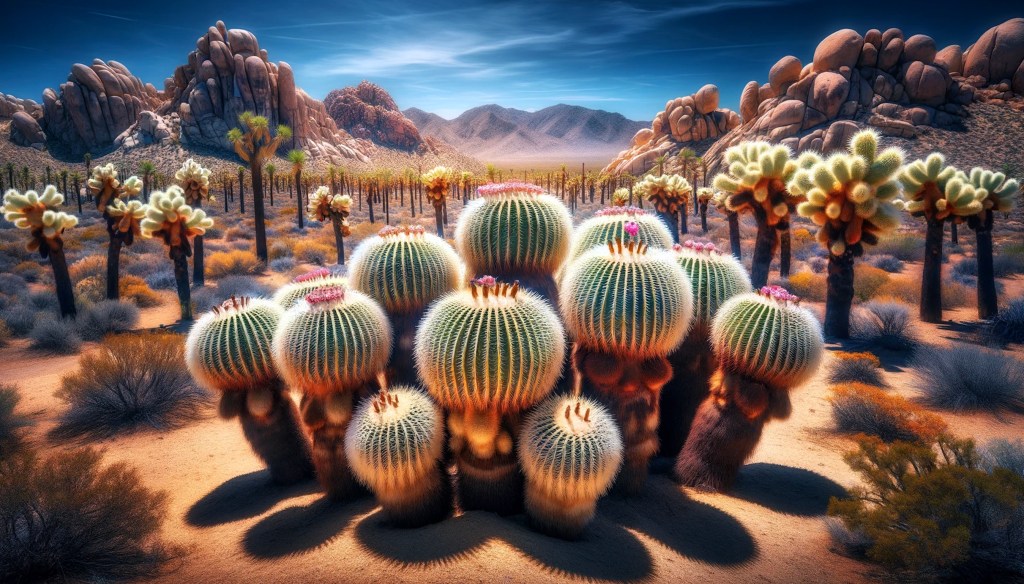
Cacti are popping up all over the place in Joshua Tree! These prickly, adaptive buddies are everywhere, from rocky ledges to sandy washes, thriving in the ultra-dry Mojave Desert and even drier Colorado Desert. Most cacti, as succulents, have thick, fleshy parts designed to store water. A lot of the cacti you’ll see in the park have sharp, protective spines, which are actually a type of modified leaf. Cacti, especially prickly pears, were an important food source for Indigenous people of the desert and to this day pop up in modern cuisine.
During your visit to the park, see how many different types of cacti you can spot. Some common cacti found in Joshua Tree National Park include:
Silver Cholla
Silver cholla (Cylindropuntia echinocarpa) — Silver chollas have branches made up of cylindrical tubes covered in straight grayish-yellow spines. The chollas are tall and can grow over 6 feet (2 m) in height. They bloom in early-to-late spring and their flowers are yellow-green or brownish-pink.
Teddy-Bear Cholla
Teddy-bear cholla (Cylindropuntia bigelovii) — The cuddly-looking teddy-bear cholla has lobes covered in thin, silver-white spines with prickly barbs. The spines darken with age, leaving the darkest ones towards the bottom of the cactus, which gives it a soft, ombre appearance. The top stems of the teddy-bear cholla are usually horizontal, and sport yellow-green flowers in the spring.
Pencil Cholla
Pencil cholla (Cylindropuntia ramosissima) — Pencil chollas can resemble large shrubs, growing up to 6 feet (2 m) in height. They have many narrow green cylindrical branches, often with a single very long and very straight spine. Pencil cholla have small pinkish-brown flowers which bloom in the spring and summer.
Tulip Pricky Pear
Tulip prickly pear (Opuntia phaeacantha) — Mojave prickly pear cacti usually grow in mound-shape bunches. The cacti have flat, fleshy pads protected by clusters of spines. The spines usually have an ombre look, with a lighter coloring on spines at the top and darker coloring on spines at the bottom. The base of the spines also sport small tufts full of barbed bristles (hence the name prickly pear). Tulip prickly pears bloom in the late spring and early summer with bright yellow flowers with green or orange-red centers.
Beavertail Prickly Pear
Beavertail prickly pear (Opuntia basilaris) — Beavertail cacti have flat, bluish-gray pads—up to a hundred of them! The cactus usually doesn’t have spines but does have small barbed bristles called glochids. In the spring, beavertail cacti bloom with deep pink flowers.
Pancake Prickly Pear
Pancake prickly pear (Opuntia chlorotica) — This type of cactus is also known as a dollarjoint prickly pear or a flapjack prickly pear. Pancake cacti have rounded bluish-green pads full of bristly yellow spines. They usually grow in upright bushy clumps and can reach over 6 feet (2 m) tall. In the late spring, they blossom in yellow flowers with a tinge of red towards the base.
Hedgehog Cactus
Hedgehog cactus (Echinocereus engelmannii) — Hedgehog cacti usually grow in clusters. It has a cylindrical stem that grows upright but dips against the ground with age. The cactus is ribbed, which helps it store water and is covered in a variety of spines. The hedgehog cactus blooms in late spring with a brilliant magenta flower.
Mojave Mound Cactus
Mojave mound cactus (Echinocereus mojavensis) — The Mojave mound cactus, as its name suggests, likes to grow in a mound shape. It is very spiny, with an almost woolly-like appearance. It blooms in the spring with a flame-red flower loved by hummingbirds.
Cottontop Cactus
Cottontop cactus (Echinocactus polycephalus) — The cottontop cactus tends to grow in clusters of about 20 to 30 heads on rocky hills and ledges, as well as gravelly and sandy valleys. It has dense spines which are yellow to red in color and look wiry and woolly. The cottontop cactus blooms in the spring and in the dead of summer with yellow flowers.
Cushion Foxtail Cactus
Cushion foxtail cactus (Coryphantha alversonii) — Cushion foxtail cacti like to grow in clusters and are native to the southern mountains of the Mojave Desert. They are an especially vulnerable species. The cushion foxtail cactus has black-tipped spines and blooms in the late spring with lavender flowers.
Barrel Cactus
Barrel cactus (Ferocactus cylindraceus) — Barrel cacti are cylindrical and spherical, which help them store water. They favor rocky, gravelly habitats. Older cacti can reach over 6 feet (2 m) in height. The cactus has many straight, red spines when new and curved, gray spines when old. In the spring, it blossoms with a maroon flower with a yellow interior.





 Pudgy Buffalo
You must be logged in to post a comment.