From Lazy Hiking: Joshua Tree National Park:
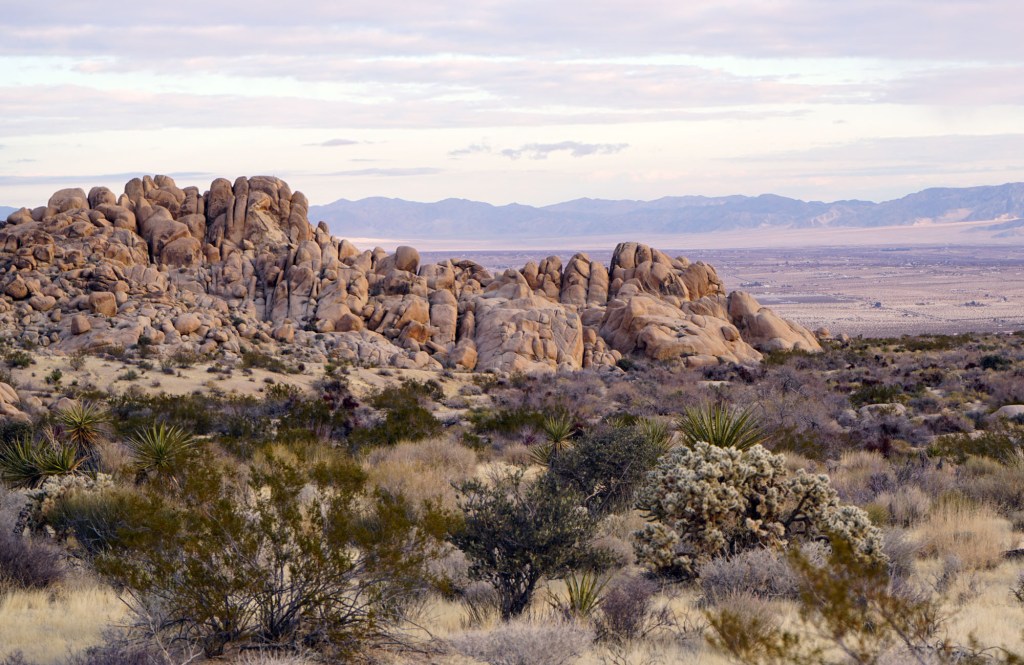
Indian Cove touches the northern border of Joshua Tree’s incredible Wonderland of Rocks. Long before Joshua Tree became a national park or even a national monument, Indian Cove was an important meeting point for Indigenous people. Native tribes used trail networks at Indian Cove to connect with larger trade routes through the Mojave Desert, along the Lower Colorado River Valley, and beyond. Throughout the park’s written history, Indian Cove has always been a popular picnicking and recreation spot for desert visitors and outdoor adventurers.
At 3,200 feet (975 m), Indian Cove lacks the of immense Joshua tree groves of Black Rock Canyon, and instead amazing rock formations pop up to delight the eye. While a few tricky (and sometimes extremely dangerous) trails wind through the Wonderland of Rocks from Indian Cove to connect to the park’s interior, there are no roads which lead from Indian Cove into the heart of Joshua Tree. West of Indian Cove, West Entrance Station is the main entry point into Joshua Tree National Park for folks traveling from Los Angeles. West Entrance Station easily connects via Park Boulevard to most of the best-loved sights in Joshua Tree.
1. Indian Cove Nature Trail
The Indian Cove Nature Trail, located in the northern part of Joshua Tree National Park, is a leisurely 0.6-mile (1 km) interpretive loop. The nature trail allows you to delve into a significant area of human history and explore a captivating desert alcove teeming with various forms of life. Informative signs placed strategically along the trail offer hikers valuable insights into the distinctive desert ecosystem of the region, its surprisingly diverse biome, and the strategies employed by its inhabitants to thrive in this unique environment. This relatively short and mostly flat path briefly descends into a dry wash, providing an easy interpretive walk that can also serve as a gentle warm-up for more challenging hikes.
2. Boy Scout Trail
Explore the beauty of Joshua trees, rugged boulders, and the vast open desert as you put your outdoor skills to use on the Boy Scout Trail! This trail offers a challenging point-to-point hike that travels from the south to the north through park’s rocky interior. Covering a distance of 8 miles (12.9 km), it takes you through the remote desert backcountry. Expect to navigate boulders and occasionally face trail-finding challenges. Embarking on this adventure requires extra preparation due to its rugged nature. Following the classic scouting motto “be prepared” is essential.
To hike the Boy Scout Trail point-to-point, where you finish at a different location from your starting point, advance planning is necessary for arranging a car shuttle to the endpoint. Additionally, for less experienced hikers, attempting this 16-mile (25.7 km) out-and-back route is not recommended.
While the trail is not excessively steep in most sections, it does involve an elevation change of over 1,100 feet (335 m). Starting at the Keys View trailhead is advisable for a mostly downhill descent towards the trail’s end at Indian Cove. Keep in mind that the trail covers 8 miles (12.9 km) of open desert, and there are no water sources along the way, so you must carry all your water.
3. Willow Hole
Follow the white tank granite and “go down the Willow Hole” on this difficult 7.2-mile (11.6 m) out-and-back hike through the heart of the Wonderland of Rocks to an enchanting willow-lined pool hidden inside Joshua Tree’s boulder paradise. Along the way, see extraordinary desert flora while navigating fantastical rock formations leading to the wildlife hotspot. Although the Joshua tree-lined trail is gentle leading to the rocky gateway, the interior of the labyrinth is a bit of a scramble to the seasonal watering hole. The Wonderland of Rocks can be difficult to navigate and disorienting with its towering stacks, and many adventurers have needed to be rescued after getting lost. Do not attempt this hike unless you have good way-finding skills, robust orienting tools, proper maps, and plenty of water. This challenging hike is not recommended for casual hikers.
4. North View, Maze and Window Loop
Explore the finest offerings of northern Joshua Tree National Park with this extensive high-desert circuit. Three distinct loop hikes – North View, Maze Loop, and Window Loop – are arranged in a stacked fashion, with North View to the north, Maze Loop in the middle, and Window Loop to the south. These loops can be combined in various ways, and a popular route outlines the outer perimeter that encompasses all three, creating a challenging 7.4-mile (11.9 km) loop. This rugged circuit adventure takes you through the rocky Mojave Desert, where you’ll encounter mesmerizing landscapes, captivating rock formations, photogenic desert flora, and breathtaking panoramic vistas.
5. Rattlesnake Canyon
Rattlesnake Canyon is a challenging, “make your own adventure”-type hike up a small canyon southeast of Indian Cove Campground, near the Rattlesnake Canyon Picnic Area, to a wild nook in the Wonderland of Rocks sometimes flowing with secret rock pools, a grotto, and a cool desert stream. The 2.6-mile (4.2 km) hike follows a lush desert wash meandering into a canyon and then seriously scrambles over big boulders, gaining nearly 400 feet (122 m) in elevation to press further up the narrow channel into the wonderland. Although the out-and-back route isn’t egregiously long, trail-finding is difficult here and the hike’s required bouldering requires some technical skill, including squeezing through tight areas which may be too tricky for novice hikers.






 Pudgy Buffalo
You must be logged in to post a comment.