
From Lazy Hiking: Joshua Tree National Park:
How far would you go to make your fortune? What would you do to stake your claim? This ain’t some cowpoke fiction, it’s true life! Hold on tight as the lawless west and a wild world of lucky strikes, murderous outlaws, gunslingers, big spenders, and lots and lots of gold call from the grave on this easy .5-mile (.8 km) to 1.6-mile (2.6 km) out-and-back hike to Desert Queen Mine! Desert Queen Mine was one of the most profitable mines in the park… and one of the most sordid. Her nomination form to the National Register of Historic Places ominously states that she “…brought death rather than fortune to [her] discoverer…” And indeed, this hike packs more drama than a western serial, with plenty of nooks, ruins, and artifacts to explore on an unforgettable jaunt to the historic mine site. Physically, the hike is easy, but is your spirit strong enough to visit the dark queen?
Directions: Desert Queen Mine Trail is located at the end of Desert Queen Mine Road, about 200 feet northeast of the intersection of Desert Queen Mine Road and Queen Valley Road. (Desert Queen Mine Road can be found off of Park Boulevard to the north, opposite Geology Tour Road.) Desert Queen Mine Road and Queen Valley Road are dirt roads with washboard rippling, usually easily passable by car. Three trailheads (Desert Queen Mine, Pine City, and Lucky Boy) leave from the parking area at the end of Desert Queen Mine Road. Signage near the parking area points to each trail. Double-check before starting your hike that you’re heading down the correct trail. The trail to Desert Queen Mine leaves from the northeast end of the parking area, to the right of the primitive toilet.
Trail Note: Desert Queen Mine entry points have been sealed, and entry into the mine is strictly prohibited. Heed warning signs!
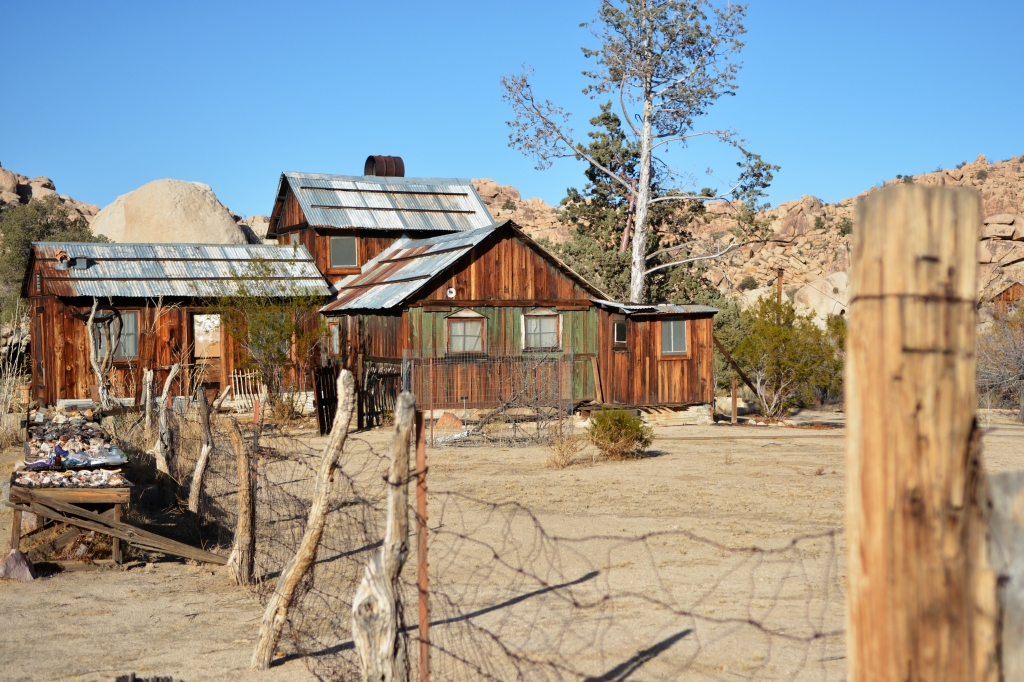
Hike It: Follow Desert Queen Mine as it traces the footprint of an old mining road. Head northeast on Desert Queen Mine Trail, through the Mojave Desert into the hills surrounding Queen Valley. Joshua trees, scrub brush, yuccas, and beavertail cacti speckle the rocky desert landscape here. In .1 miles, the trail forks. The road straight ahead leads to the ruins of a miner’s cabin and a great overlook of Desert Queen Mine. The trail to the right is a continuation of Desert Queen Mine Trail, which heads down into the gully and then up the White Tank monzogranite hillside to visit the mine shafts.
Making a Living… and a Killing. Frank L. James was ecstatic. The 29-year-old from Wisconsin had been working hard as a laborer at Lost Horse Mine, dreaming of one day filling his own pockets with gold just like he mined for his bosses. Chasing his dreams, he spent his days off in the hills around Queen Valley, prospecting on his own. And in the 1890s, his explorations paid off. He hit a massive gold-bearing vein hidden in the White Tank monzogranite stacks tucked above a gully north of Lost Horse. Finally things were falling into place for James. But Lost Horse had another opportunistic prospector in the neighborhood, ex-convict and former San Quentin Prison inmate Charley Martin. Charley Martin, who ran with the notorious McHaney Gang, became suspicious of James’ newfound wealth. So Martin and his associates did what any gang of outlaws would do—they broke into James’ cabin, found some telltale ore, and hatched a plan. And so, one night, the gang hid in the hills around the cabin and shouted to James that they found gold and wondered if it was his. When James went to investigate, Martin shot him dead. With the hopeful miner now out of the way, the gang successfully jumped his claim.
Martin was tried for the murder of Frank L. James. But, when the case went to trial, there were no credible witnesses that could recount what happened that dark night. In what many consider a grave miscarriage of western justice, a jury found Martin not guilty for the cold-blooded killing of James, stating that James had a knife when Martin shot him in self-defense.
Following James’ untimely death, gang honcho Jim McHaney made the appropriate payouts to Martin and those involved and conveniently took over what is now known as Desert Queen Mine. Some say McHaney was the true mastermind who ordered the claim to be jumped and James killed. Rumors also swirled during this era with the Los Angeles Times reporting in 1895 that McHaney’s new mine was the fabled lost mine of larger-than-life southwestern frontiersman Pegleg Smith.
McHaney ultimately lost Desert Queen Mine (known then as McHaney Mine) after borrowing too largely against its profits causing the big ol’ bank to foreclose on it. McHaney later abandoned prospecting for counterfeiting coins out of gold-plated lead pieces, getting busted by the US Department of the Treasury and receiving 17 years in prison for his endeavors. The mine passed into the hands of Bill Keys who took possession of it for backpay owed for his work as a custodial steward for the mine. The mine ran sporadically until 1961. As for Martin, he later became San Bernardino Police Chief, for two months, that is, before getting ousted back to Queen Valley.
Spur Path: The path straight ahead is relatively flat, and is a fun option for a quick look at Desert Queen Mine. Along the way, you’ll see rusty bits of detritus poking about the desert floor, inexplicably befitting the prickly landscape, while being out of place in the beautiful desert hills. It’s easy to wonder at the transformation of junk into artifact. Ponder the paradox, but leave what you discover be; these items may be abandoned but they’re protected and important relics of the park’s industrial history.
To the right of the path, look for what remains of a stone miner’s cabin. The crumbling walls of this structure used to be over 7 feet (2 m) tall. Further down the path are an old tank which stored cyanide used to separate gold from ore, and a winch with cables. The spur ends in a loop on a flat overlook of Desert Queen Mine. Look across the gulch to see its many mine shafts. The site includes at least nine shafts (vertical or incline passages) and ten adits (horizontal tunnels), many visible from the lookout. Also note the piles of discarded tailings. Tailings are the material leftover from processing ore. These tailing piles provide clues as to how much ore was extracted from the mine. The main tailing pile rose over 65 feet (20 m) high and still spills into the appropriately named Gold Dust Gulch. The US Bureau of Mines projects that 3,845 ounces of gold was produced from the mine, which operated from 1895 to 1961. The lookout is .25 miles from the trailhead.
Main Trail: Backtracking to the first trail fork, the Desert Queen Mine Trail continues down the path to the right (south) which leads down into the gulch and then up to hillside to visit the mine shafts, a jumble of old machinery, and tailing piles. Follow the trail south as it dips down the hillside, turning east and then dropping south again to meet a wash in Gold Dust Gulch. Along the way, as the path winds around the contours of the chunky desert slopes, keep an eye out for more rusty relics, scrap metal, and piping, as well as a stone foundation from an old miner’s camp. Great views of the mine shafts and the large tailing pile will be visible to the north. Cross over the little canyon wash and make a hairpin turn to the left (north) to climb up to the heart of the mine. Odd bits of mining machinery are strewn about the wash and the slopes, and here you can see tramway track ties, iron bins, an iron wheel, a Chicago Pneumatic air pump, old timbers, and even some old glyphs carved into the rocks by miners. Reach Desert Queen Mine .15 miles from the wash, and .7 miles from the trailhead.
Notice that the Park Service has sealed off the entrances to Desert Queen Mine, and for good reason. While beguiling, mines are incredibly dangerous. Bodily injury or even death can result from deadly gas, reduced oxygen, cave-ins, rotten structures, and hidden explosives. You can certainly get a peek inside the heart of the hills through the bars around the mine passages, but also beware of its flying gatekeepers—bats. Some visitors have leaned in for a good look at Desert Queen Mine’s golden innards and have received a face full of bats in return.
Certain species of bats love to roost in subterranean spaces and the quiet, dark abandoned mines provide vital habitats to these bat colonies. Bats may abandon their habitats if humans enter, and may deplete important energy resources if they are disturbed during hibernation. Humans can also transport fatal fungi to bats which may develop into fatal White-nose syndrome. Take care when visiting the mine to help protect the park’s bats.
Have fun and be careful when enjoying villainously royal Desert Queen Mine, one of Joshua Tree’s most successful mines, chock full of alluring stories, a checkered past, and a captivating history. When you’re finished exploring the mining complex, retrace your steps back to the parking area.




 Pudgy Buffalo
You must be logged in to post a comment.